

This page is written for two kinds of player: someone who has never dealt a hand and needs the setup plus the handful of rules that govern every move, and someone who already plays and wants the two things most FreeCell pages get wrong — how many cards you can actually move at once, and how many deals are genuinely unsolvable.
Key Takeaways
- Every card in FreeCell is face-up from the first second. The game hides nothing, which is why it rewards planning rather than luck.
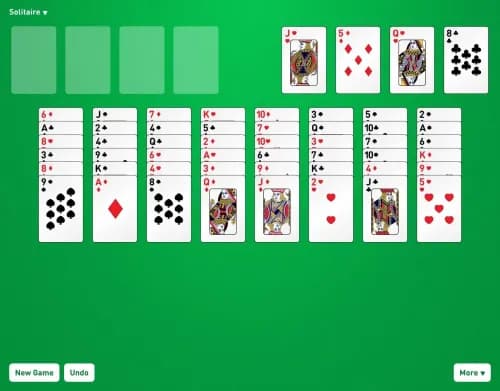
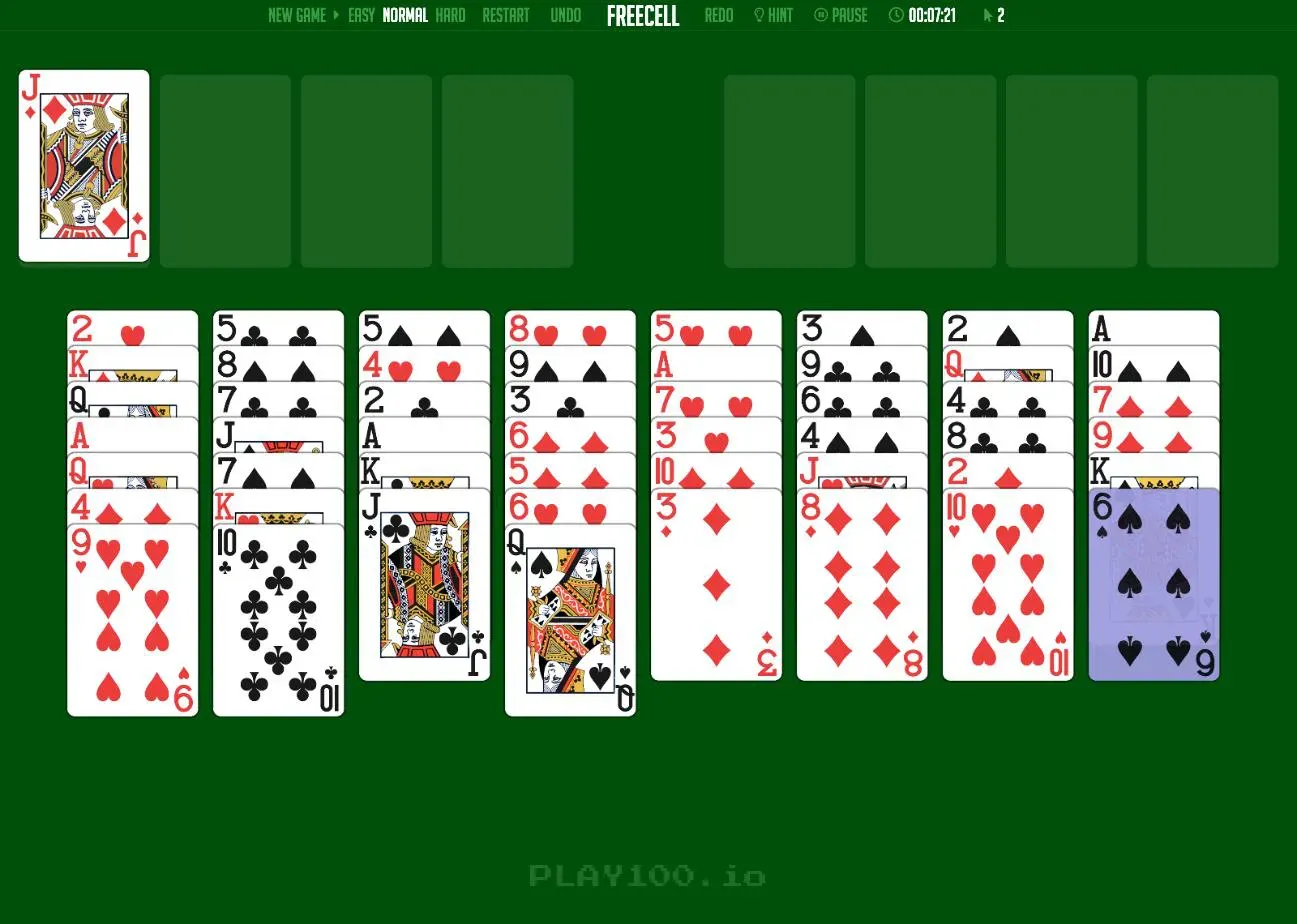
- A FreeCell deal uses four free cells, eight columns and four foundations. The columns hold seven, seven, seven, seven, six, six, six and six cards.
- You never move a stack — the game moves it for you, one card at a time. How big a stack you can shift is set by a formula, not by a limit the game picked.
- Almost every FreeCell deal can be won. Of the 8,589,934,591 deals in the standard numbering, 102,075 are impossible, roughly one in 84,000.
- FreeCell deal #11982 is the famous one: the single unsolvable hand among Microsoft's original 32,000.
- Three difficulty settings sit on the toolbar and switch with one click, along with Hint, Undo, Redo and Restart.
What Is FreeCell?
FreeCell is a single-player card game in the solitaire family, played with one standard 52-card deck. FreeCell shares its goal with Klondike, the game most people mean when they say "solitaire": move all 52 cards onto four foundation piles, one per suit, each running Ace up to King.
What separates FreeCell is information. Klondike buries most of the deck face-down and hands you a stock pile to turn over, so a game can be lost to a card you were never shown. FreeCell deals everything face-up on the first screen. The entire problem is visible before you touch anything, and the four open cells give you somewhere to put a card while you dig out what is underneath it.
Dealing every card face-up is why FreeCell has a reputation as the thinking player's solitaire, and why nearly every deal it produces can be beaten by someone playing well enough.
FreeCell Setup: What Is on the Table
A FreeCell board has three areas, and every rule in the game refers to one of them.
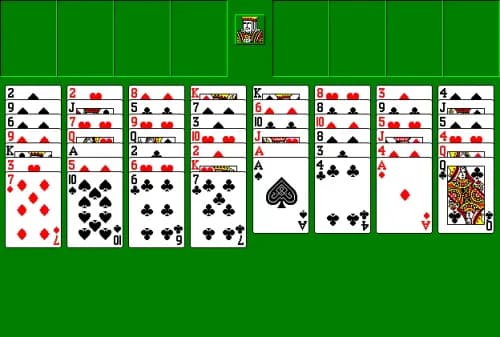
- The tableau: eight columns across the middle holding all 52 cards, face-up. The first four columns get seven cards each, the last four get six.
- The free cells: four empty slots at the top left. Each holds exactly one card, of any rank or suit, for as long as you want.
- The foundations: four empty piles at the top right. These are what you are filling, one suit each, Ace first and King last.
There is no stock pile and no waste pile. Once the deal finishes, no new card ever enters the game.
How to Play FreeCell
You play FreeCell by moving all 52 cards onto the four foundations, one suit per foundation from Ace to King, using the four free cells and any empty columns as temporary space. Four rules govern every move you are allowed to make.
The four rules that decide every move
- Only the bottom card of a column is available, along with any card sitting in a free cell.
- Build columns downward in alternating colors. A red seven goes on a black eight; a red seven on a red eight is illegal.
- A free cell takes any single card. Getting it back out later is your problem, which is what makes cells expensive.
- Foundations build up by suit from the Ace. The two of hearts only goes on the Ace of hearts.
An empty column is the strongest position in the game. Any card, or any legal run, meaning a sequence already stacked downward in alternating colors, may be placed into one, and as the next section explains, an empty column is worth more than a free cell.
Controls on this page
- One click moves a card. Click a card and it travels to a legal destination on its own: a foundation if one will take it, otherwise a column. We measured this: a single click on the jack of diamonds sent it onto the queen of spades and ticked the move counter from 0 to 1.
- Drag when you want to choose the destination yourself. Auto-move picks for you; dragging overrides it. Dragging that same jack into an empty free cell worked and the counter advanced again.
- Hint tints a playable card purple. Pressing it highlighted the six of spades on our board.
- Undo and Redo sit on the toolbar as buttons. Undo reversed our jack move and returned the card to its original column.
- Easy, Normal and Hard are printed on the toolbar itself, not buried in a menu. Clicking one deals a fresh hand at that setting immediately and resets the clock.
- Restart replays the same deal from the beginning, and Pause stops the timer.
How Many Cards Can You Move at Once?
With all four free cells empty and no empty column, you can move five cards at once. FreeCell itself only ever moves one card at a time. When you drag a run of five cards onto a column and the game accepts it, what actually happened is that the game shifted those cards one at a time through your empty cells and empty columns, then put them back in order. If it does not have enough empty space to do that, the move is refused.
This is the rule that confuses more new FreeCell players than any other, and most FreeCell pages skip it entirely.
The size of the biggest run you can move is given by a formula. Wikipedia states it as C = 2^M × (N+1), where N is the number of empty free cells and M is the number of empty columns. In plain terms: every free cell adds one card, and every empty column doubles the total. The table below assumes you are moving onto a column that already has cards in it.
| Empty free cells | 0 empty columns | 1 empty column | 2 empty columns |
|---|---|---|---|
| 4 | 5 cards | 10 cards | 20 cards |
| 3 | 4 cards | 8 cards | 16 cards |
| 2 | 3 cards | 6 cards | 12 cards |
| 1 | 2 cards | 4 cards | 8 cards |
| 0 | 1 card | 2 cards | 4 cards |
Two things fall straight out of that table. Filling all four cells cuts you from moving five cards to moving one, which is how a winnable position turns into a dead one. And an empty column is worth far more than a free cell: emptying a column doubles your capacity, while freeing a cell adds a single card.
One exception matters, and it follows from how the move actually works. If the empty column is the destination, it cannot also serve as scratch space for the shuffle, so it drops out of the count. Wikipedia puts it as a straight halving: the maximum that can be moved to an empty cascade, its term for a tableau column, is C / 2. With four cells and one empty column you can move ten cards onto an occupied column, but only five into the empty one.
The same arithmetic explains the variant family. A FreeCell board with three cells instead of four is not slightly harder, it is a board where your maximum run drops from five cards to four before you have played a move.
Is Every FreeCell Deal Solvable?
Almost every FreeCell deal is solvable: roughly one deal in 84,000 cannot be won. The exact figure is better known for FreeCell than for any other solitaire game, yet nearly every FreeCell site states it wrong. Some claim 99%. Others say flatly that every game can be won, which is false.
Theodore Pringle and Shlomi Fish ran a solver across the full standard range of 8,589,934,591 deals and found 102,075 impossible ones, about one impossible deal in every 84,000. Wikipedia summarises the same result as roughly 99.999% of deals being solvable.
The famous exception has a number. Microsoft's original set of 32,000 deals contains exactly one hand nobody can win, and it is deal #11982. Michael Keller of Solitaire Laboratory, who contributed 1,970 solutions to Dave Ring's Internet FreeCell Project, records that 11982 has resisted thousands of human solvers and eight independent computer programs. It is worth being precise about this, because it is commonly described as the first unsolvable deal: it is the only unsolvable deal in that set.
If you lose a FreeCell hand, the odds overwhelmingly say the deal was winnable and the loss was yours. That is the opposite of Klondike, whose unwinnable share has never been settled by an exhaustive search the way FreeCell's has.
Strategy: How to Win More Games
- Look before you move. Everything is face-up, so the information you need is already on screen. Find the Aces and twos and work out what is buried on top of them.
- Treat free cells as debt. A card in a cell is a card doing nothing, and it shrinks the run you can move. Put cards in cells with a plan for taking them out.
- Chase empty columns harder than empty cells. The formula above is the whole argument: a column doubles your capacity, a cell adds one.
- Do not send everything to the foundations. A low card left in the tableau is often the only landing spot for a card you still need to move. Foundations are permanent.
- Work on the shortest column. The six-card columns are the cheapest to empty, and the first empty column is the one that changes the game.
Where FreeCell Came From
Paul Alfille invented FreeCell in 1978 by changing one rule in an older game called Baker's Game. That documented origin is unusual for a solitaire game.
Baker's Game was described by Martin Gardner in Scientific American in June 1968 and named for C. L. Baker, and it builds columns down in the same suit. Alfille, then a medical student at the University of Illinois, let columns build down in alternating colors instead. That single change turned a difficult game into one where almost every deal is solvable, and FreeCell existed. He wrote it in the TUTOR programming language for the PLATO educational computer system.
FreeCell reached the wider world through Jim Horne, who learned it on PLATO and wrote character-based DOS and graphical Windows versions. Keller records that his version shipped in Microsoft Entertainment Pack 2 in 1992, and Microsoft has included a FreeCell implementation in every release of Windows since 1995. That is why so many people remember it as the game that came with the computer.
If it is the Windows version you are thinking of, the Windows XP FreeCell page is the one to try.
Difficulty Settings, and What We Did Not Test
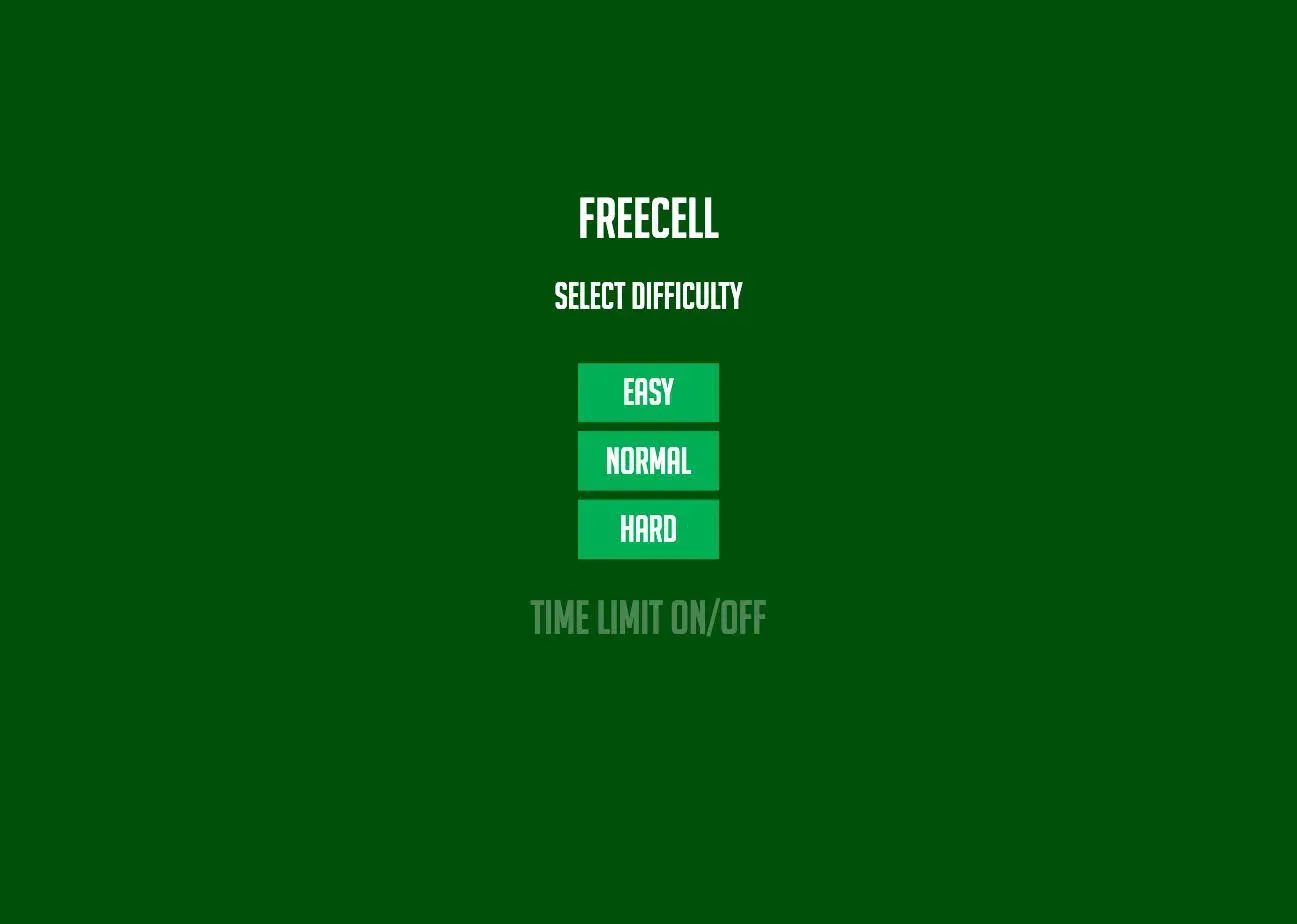
The board opens on a difficulty screen offering Easy, Normal and Hard, with a Time Limit switch underneath it. All three stay on the toolbar during play, so switching is one click rather than a trip back to a menu. We confirmed this by clicking Hard mid-game: the board dealt a fresh hand, the clock reset to zero, and Hard became the highlighted label.
We did not measure what Easy, Normal and Hard actually change. Doing that honestly would mean playing a meaningful number of hands at each setting and comparing them, and we played one Normal hand and started one Hard hand. So this page claims only that the three settings exist and switch instantly. We also did not test what the Time Limit switch does, and we make no claim about how fast the deal animation runs, because a browser throttles animation in a background tab and any number we recorded would describe our test conditions rather than your game.
FreeCell Variants You Can Play Here
FreeCell is a family, not one game, and the variants mostly change one of three things: how many free cells you get, how many columns, or how many decks.
If you already win most standard deals, drop a cell. If you want a board that plays like FreeCell but demands exact suit order, take Baker's Game. If you want a longer game rather than a harder one, take a multi-deck board.
Changing the cell count is the cleanest lever, and the table above already tells you what it costs. Fewer cells means a smaller maximum run before you have made a single move:
- ThreeCell: three cells, maximum run of four
- TwoCell: two cells, maximum run of three
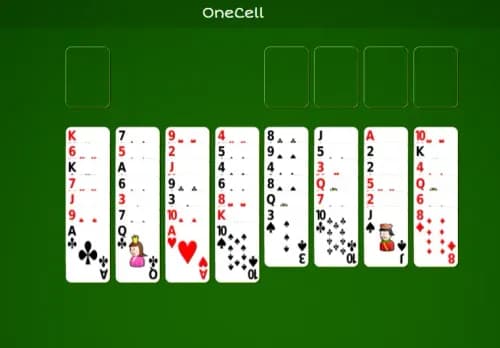
- OneCell: one cell, maximum run of two
Baker's Game is the ancestor rather than a variant, and the difference is the one Alfille changed: Baker's Game builds columns down in the same suit instead of alternating colors, which is what makes it markedly harder. Eight Off sits in the same family tree.
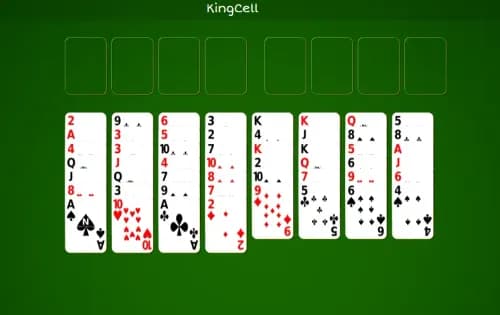
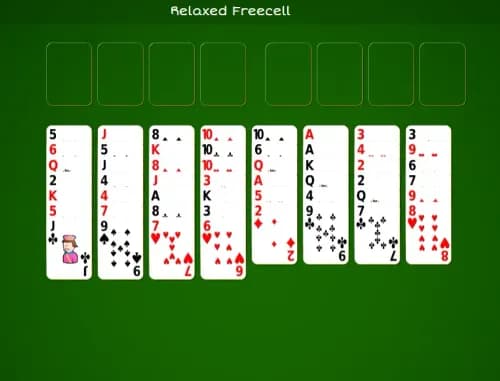
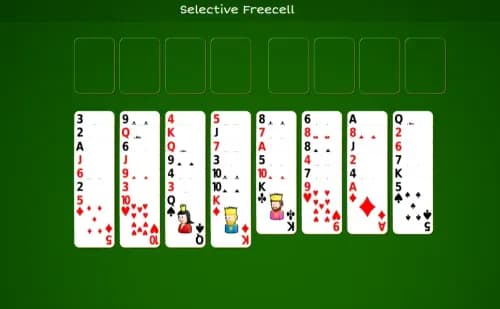
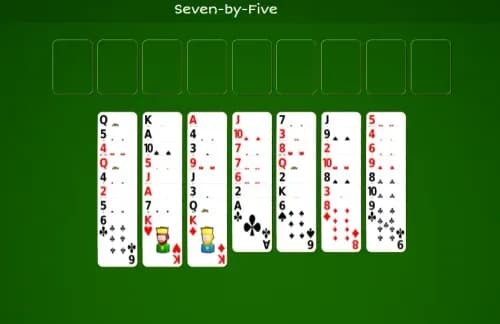
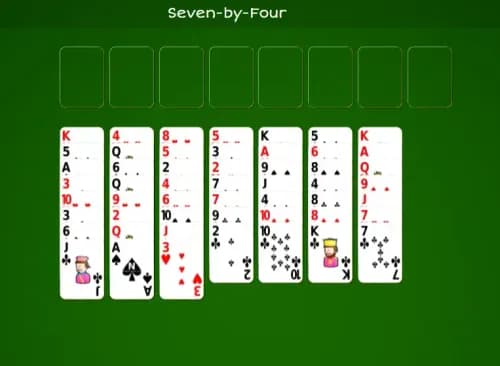
The rest change the shape of the board or the size of the deck: Double FreeCell, Triple FreeCell and Big FreeCell deal more than one deck; Seven by Five, Seven by Four and Six by Four change the column count; and Forecell, Sea Towers, KingCell, Relaxed FreeCell, Selective FreeCell, Inverted FreeCell, Chinese FreeCell and Luckier Thirteen each adjust the rules in their own way. Each has its own page with its own board.
How We Tested This Page
Every claim above about the board comes from playing it on 25 August 2026, not from a specification. We opened the game, dealt a hand on Normal, and recorded what happened: the columns held seven, seven, seven, seven, six, six, six and six cards, all face-up; a single click auto-moved a card and advanced the move counter; a drag placed a card into a free cell that auto-move would not have chosen; Hint tinted a card purple; the Undo button reversed a move; and clicking Hard on the toolbar dealt a new hand and reset the clock.
Two things did not behave as documentation elsewhere suggested. Ctrl+Z did nothing — undo works through the toolbar button, not that shortcut. And moving a card takes one click, not the two-step select-then-place sequence sometimes described. Where we could not test something properly, the section above says so rather than guessing.
The history and solvability figures come from three independent sources of different kinds: the Wikipedia article on FreeCell, the FreeCell Pro solvability report published by Shlomi Fish, and Michael Keller's FreeCell FAQ at solitairelaboratory.com.
Ready to Deal?
Pick a difficulty and the board deals itself. Everything is face-up, the odds say the hand can be won, and the only thing standing between you and the four foundations is the order you choose to dig.